ICPC State Pages
Home | Change State | Search
About the ICPC
The Association of Administrators of the Interstate Compact on the Placement of Children (AAICPC) was established in 1974 and consists of members from all 50 states, the District of Columbia and the U.S. Virgin Islands. The AAICPC has authority under ICPC to "promulgate rules and regulations to carry out more effectively the terms and provisions of this compact." The AAICPC obtains its Secretariat Services, as an affiliate of the American Public Human Services Association (APHSA).
For more information, please visit the AAICPC website.
Contact the AAICPC
American Public Human Services Association
1133 Nineteenth Street, NW
Suite 400
Washington, DC 20036
(202) 682-0100
fax: (202) 289-6555
Web Manager: Carla Fults [cfults@aphsa.org]
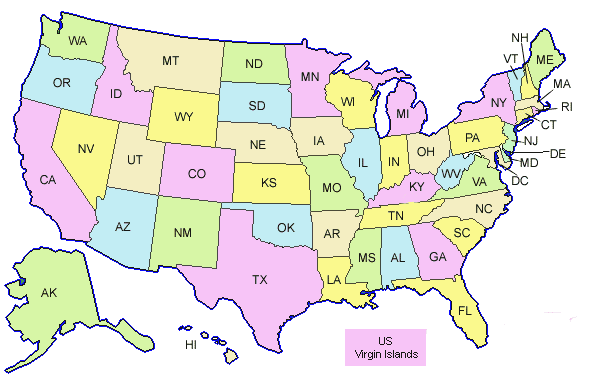
Click on a state to see it's page:
Rhode Island
-
Adoption
- Age of Majority
- Appeals
- Border Agreements
- Criminal Background Checks/Abuse and Neglect Registry
- Custody Matters
- NON ICPC - Consultants/Specialists
- Definitions
- Education - Public Education Costs
- Financial Plans, Medicaid, IV-E, Daycare, Payments
- Foster Care
- Home Studies (Adoption/Foster Care/Kinship/Parent/Relative)
- ICPC Processing
- Licensing/Certification/Approval
- Parental Placements
- Relative Placements
- Residential Treatment Centers/Facilities
- Supervision/Reports/Guidelines
- Termination of Parental Rights (TPR)
Compact Administrators
| Compact Administrator Martha Dolan Department of Children, Youth & Families
|
Deputy Compact Administrator Lori DAlessio—contact only in administrators absence Cheryl Lepre—contact only in administrators absence
|
Consultants
| ICPC Specialist (A-H) | Administrative Assistant (A-L) N/A |
| ICPC Specialist (I-Q) N/A |
Administrative Assistant (M-Z) N/A |
| ICPC Specialist (R-Z) N/A |
Mailing Address
| Regular Mailing Address 101 Friendship St. |
Federal Express Address 101 Friendship St. |
Useful Telephone Numbers
| Child Abuse Hotline 1-800-RI- CHILD or 1-800-742-4453 (in and out of state) |
Juvenile Compact Office William Dolan, ICJ Deputy Administrator |
| Mental Health Compact Office No information provided |
Useful Websites
General Iinformation
Co-Located Compacts - ICPC, ICAMA, ICJ
Adoption
Independent /Private
Independent/Private Adoptive Placements:
Rhode Island permits private attorney, private agency and/or independent adoptions
| Adoption Type | Yes/No |
|---|---|
| Private Agency | Yes |
| Private Attorney | No |
| Independent | Yes |
Adoption Statute-Non-Agency; Independent; Private Adoptions:
§ 15-7-11 Investigation and report as to adoptive home. – (a) Upon the filing of a petition so presented and consented to for the adoption of a minor child, the court shall notify the Department of Children, Youth and Families. It shall then be the duty of the department to verify the allegations of the petition, and to make appropriate investigation to determine whether the proposed adoptive home is a suitable home for the child. The department shall within sixty (60) days submit to the court a full report in writing, with recommendation as to the granting of the petition and any other information regarding the child or the proposed home which the court shall require. In circumstances where the petition for adoption concerns a child who has been placed for adoption by a duly licensed child placement agency, the court may accept the home study report of the child placement agency in lieu of the investigation and recommendation of the Department of Children, Youth and Families; provided, the child placement agency includes in its home study report any criminal record of the prospective adoptive parent. All costs relating to criminal background checks shall be the responsibility of the public or private entity conducting the home study;
(b) As part of the investigation or investigative home study report, a request shall be made to the attorney general through the division of criminal identification to make available any criminal record of the prospective adoptive parent maintained by the division. The prospective adoptive parent shall apply to the bureau of criminal identification of the state police or the local police department for a nationwide criminal records check unless they have previously submitted to a nationwide criminal records check in accordance with § 14-1-34 and/or §§ 40-13.2-2, 40-13.2-4 and/or 40-13.2-5 and/or §§ 16-48.1-4 and 16-48.1-5. The attorney general shall immediately comply with the request of the department or child placement agency and the report of the attorney general shall be made part of the investigative home study submitted to court.
(c) Pursuant to § 40-13.2-4, the director of DCYF will determine by rules and regulations those items of information appearing on a criminal records check which constitute disqualifying information because that information would indicate the prospective adoptive parent could endanger the health or welfare of a child or children. Upon the discovery of any disqualifying information with respect to a proposed prospective adoptive parent, the agency conducting the home study will be informed by the director in writing of the nature of the disqualifying information.
(d) At the conclusion of any criminal records check required by this section, the fingerprint card of the person subject to the nationwide criminal records check shall be promptly destroyed.
(e) Provisions of this section may, in the discretion of the court, be waived in the case of a petition for the adoption of a child where the child is the natural child of one of the parties petitioning for the adoption and resides with the petitioning parties.
(f) Specific definitions and procedures for adoptive home studies are to be provided in regulations promulgated by the department for children, youth and families in accordance with the administrative procedures act. All investigative home studies submitted to the court shall be based on a minimum of two (2) home visits by the agency conducting the home study. All prospective siblings and any other household members shall be interviewed during a home visit. Agencies conducting the home study shall have a minimum of one home visit following completion of the home study process. A summary of the agency's past and present contact with the prospective adoptive family shall be included in the home study. The agency shall include in the home study its recommendations for approval or disapproval of the adoption and the reasons for its conclusion.
(g) The following information shall be included in all home studies submitted to the court:
(1) Identifying information on all household members, including minor children and the current needs of each child;
(2) Information regarding the prospective adoptive parent's motivation and reasons for the adoption;
(3) Current background information on the prospective adoptive parents, including written self-assessment;
(4) Child care experience and parenting philosophy of the prospective adoptive parents;
(5) Information regarding past and present marriage and/or partnership relationships;
(6) Current medical and psychological conditions, including addiction to drugs or alcohol of any prospective adoptive parents, that may be seriously detrimental to the health and welfare of children;
(7) Description of the home and local community, including any health and safety concerns regarding the home;
(8) Information regarding the finances and employment of the prospective adoptive parents;
(9) Reference letters from at least three (3) individuals at least two (2) of whom are non-relatives;
(10) Results of background checks with DCYF and clearance checks regarding state and federal criminal records conducted on the prospective adoptive parents;
(11) Information related to the prospective adoptive parent's willingness and ability to accept and cooperate with adoption support services, including their level of understanding regarding openness with birth family; and
(12) Information related to the match between prospective adoptive parents and the child, including attitudes and capabilities of prospective adoptive parents and the child's characteristics and background.
.
Public
Public Adoptive Placements-Requirements
As outlined in RIGL 15-7-11
INDEPENDENT / PRIVATE / PUBLIC
The following information applies to independent, private and public adoptions
Adoption Assistance
Adoption assistance payments begins
- After the adoption is finalized
Sending State Adoption Subsidy Payments (Guidelines)
Once eligibility is established as a special needs child, the Rhode Island Department of Children, Youth & Families Permanency Support Unit worker has a thorough discussion with the prospective adoptive parent(s) and then negotiates a rate with the adoptive family, based on the child’s needs and the family’s circumstances, up to, but not in excess of, the maximum allowable rate.
Special Needs
Rhode Island definition of "Special Needs"
A child must meet all of the following three requirements to be considered as a child with special needs and to be eligible for federal or state adoption assistance.
¨ A determination must be made that it is not in the child’s best interest to return home.
¨ A specific factor or condition, which could make the child difficult to place in an adoptive family without adoption assistance, must be present or for an applicable child, the child may meet all of the medical or disability requirements for Supplemental Security Income (SSI).
¨ Reasonable efforts to place the child without adoption assistance must first be made, except in certain situations when a determination has been made by the Department that it is contrary to the child’s best interests to be moved.
A specific factor or condition, which could make the child difficult to place in an adoptive family without adoption assistance, must be present or for an applicable child, the child may meet all of the medical or disability requirements for SSI. Worker must document the specific factor that makes a child difficult to place. This may require written documentation from medical, mental health, educational or other professional. Such factors include:
a. The child has a documented medical condition or a physical, emotional, or mental disability.
b. The child is a member of an ethnic or racial minority.
c. The child is over the age of nine (9).
d. The child is a member of a sibling group being adopted into the same home as a sibling.
e. The child has experienced a prior adoption disruption or dissolution.
f. The child is at high risk of developing a medical condition or a physical, emotional or mental disability, based upon family background or history. (In this situation, a child may be eligible for deferred subsidy, which would include a medical subsidy without financial assistance. In the event a disability, based upon family background or history, is diagnosed in the future, the child may then be eligible to receive financial assistance.)
Finalization
Adoption may be finalized in another state:
- Yes
Before finalization can occur in Rhode Island, child must be in adoptive placement:
- 6 months
- Other
Unless there is a waiver granted by Rhode Island Family Court
Statutory code/cite for Adoption Petition
R.I.G.L. 15-7-11 (all matters pertaining to adoption 15-7-1 to 15-7-26)
Court Jurisdiction for Adoption Cases
RIGL 15-7-4; Court jurisdiction for Statewide Family Court R.I.G.L sect. 8-10-3; R.I. G.L 14-1-5 & 14-1-6
Home Study (Adoptions)
Statutory code/cite for the Adoptive Home Studies:
R.I. G. L. 15-7-11
Prospective adoptive parents permitted to pay for a pre-adoptive home study
- Other : Must have a child specific addendum added upon birth of child.
Prospective adoptive parents permitted to pay for a pre-adoptive home study
- Private Adoptions: Yes
- Independent Adoptions: Yes
Age of Majority
State's age of majority
- 18 years
Statutory code/cite and the age of majority:
- R.I. G.L. 15-12-1
Services (after Age of Majority)
As the Receiving State, the following services will be provided/continued at the age of majority:
- Medicaid
Appeals
Appeals permitted:
- Home Study: Yes
- ICPC Decision: Yes
Border Agreements
Border Agreements permitted:
- Yes
Current Border Agreements with:
- None - Not Applicable
Criminal Background Checks/Abuse and Neglect Registry
Home Studies which Require Criminal / Perpetrator Record Checks
Rhode Island requires criminal background checks for the following home studies:
- Foster Care
- Relative Care
- Relative-Foster Care
- Foster-Adopt
- Adoption
- Parent
In parent home studies, all adult household members along with the parents will receive a state criminal background check.
In all other home study requests, fingerprinting and a state criminal background check will be conducted on all adult household members.,
Criminal Background Screening
The following methods are used to capture fingerprints to conduct criminal records checks/and abuse and neglect.
- Live Scan or other computerized technology
- Finger Print cards
- Other, specified below
Live Scan is used for fingerprinting. Fingerprint cards are only used when we cannot roll the person’s print clearly enough to be read by Live Scan. Manual records checks are abuse/neglect check.
Criminal background checks/screening via Live Scan or other computerized technology are offered at the following levels:
- National
Background Screening
State or Local Criminal Record Checks Requirements/Process:
State checks are done via selected RI DCYF staff having access to Attorney General's criminal records database.
Applicant will not be approved if the person has committed any of the following misdemeanor or felony offenses:
LEVEL 1 OFFENSES
If an individual is disqualified for the arrest and/or conviction for any of the following offenses, that individual shall have a right to appeal for the purpose of demonstrating that he or she has not been arrested and/or convicted for such an offense.
* Felony Child Abuse or Neglect
* Felony Domestic Violence
* Felony committed against a child
* 1st Degree Child Molestation
* 2nd Degree Child Molestation
* Child Pornography
* Circulation of obscene publications and shows
* Sale or exhibition to minor of indecent publications, pictures or articles
* Child nudity in publication
* Transportation for Indecent purposes
* Harboring
* Prostitution
* Pandering
* Deriving support or maintenance from prostitution
* Felony Drug Offense committed less than five (5) years ago*• Felony involving violence
* Murder
* Manslaughter
* Rape
* 1st Degree Sexual Assault
* 2nd Degree Sexual Assault
* Kidnapping
* Car-jacking
* 1st Degree Arson
* 2nd Degree Arson
* Mayhem
* Felony Assault committed less than five (5) years ago
* Felony Battery committed less than five (5) years ago
LEVEL 2 OFFENSES
If an individual is disqualified for the arrest and/or conviction for any of the following offenses, that individual shall have a right to appeal for the purpose of demonstrating his or her long standing record of excellence in child care:
• Felony Assault committed over five (5) years ago
• Felony Battery committed over five (5) years ago
• Felony Drug Offense committed over five (5) years ago
• Robbery
• Breaking and Entering
• Burglary
• Illegal Possession of a Firearm
• Misdemeanor Domestic Assault
3rd Degree Sexual Assault
If an individual is disqualified for the arrest and/or conviction for any of the following offenses, when the offense does not involve a child, that individual shall have a right to appeal for the purpose of demonstrating his or her long standing record of excellence in child care:
• Transportation for Indecent purposes
• Harboring
• Prostitution
• Pandering
• Deriving support or maintenance from prostitution
• Circulation of obscene publications and shows
Type of Checks (Crim. & Abuse Neglect Registry)
Rhode Island requires the following types of criminal background and perpetrator checks (Federal (F), State (S), Local (L), Abuse and Neglect Registry (ANR), Not Required (NR))
| Federal | State | Local | ANR | NR | |
|---|---|---|---|---|---|
| Relative | y | y | y | ||
| Relative Foster Care | y | y | y | ||
| Foster Care | y | y | y | ||
| Adoption | y | y | y | ||
| Parent | y | y |
Wait Time for Criminal Records Results
Wait time for fingerprint results are:
Live Scan or other technology
- State: 24 hours
- Local/County: 24 hours
Manually - Fingerprint Card
- State: 48-72 hours
- Local/County: Not Offered
Verification of Criminal Records Results
- Actual results/information contained in the Criminal Background
- Signature verifying background check completed
Custody Matters - NON ICPC
(NOTE: These are private or domestic custody matters brought before the court for determination/decision)
Non-ICPC Requests - (i.e. private/domestic custody cases)
ICPC Office will not investigate a domestic or private custody matter.
- Parent vs. Parent: No
- Third Parties: No
ICPC Offices will assist with referral:
- Yes
Refer Cases To:Depending on circumstances of the request- may vary case to case.
Custody Investigation
Definitions
Rhode Island Definitions
If the following terms are defined differently than below (General Definitions), please provide definitions for the following types of placements as defined within your state. If definitions in your state are the same, please type the word same in the space provided. (only 250 characters per answer will be accepted).
Adoption
Same
Foster-Adopt
Same
Foster Care
Same
Parent
Same
Relative
Same
Relative Foster Care
Same
General Definitions
Adoption
is the legal act of permanently placing a child with a parent or parents other than the birth parents. Adoption results in the severing of the parental responsibilities and rights of the biological parents and the placing of those responsibilities and rights onto the adoptive parents. After the finalization of an adoption, there is no legal difference between biological and adopted children.
The types of adoptions permitted by each state are governed by state law:
- Private Agency - are adoptions facilitated by a private licensed agency (i.e. domestic and international).
- Independent - are adoptions facilitated by an attorney, other intermediary, or adoption facilitator as defined by state law.
- Public - are adoptions facilitated by a public state or local agency and involve children who are in the custody of a state/local government agency.
Days
means “Calendar” (not business) days.
Foster - Adopt
is an individual who has been approved as a licensed foster parent and who has made an offer of an adoption commitment if the child becomes legally free.
Foster Care (Provider)
is any person other than a natural or adoptive parent with whom a child is in the care, custody, or guardianship of the State Child Welfare Agency and placed by said division, or with its approval for temporary or long-term care but shall not include any person with whom a child is placed for the purpose of adoption. Foster home means and includes private residences that are licensed, or specialized group homes.
Foster Care Maintenance Payments
means payments to cover the cost of (and the cost of providing) food, clothing, shelter, daily supervision, school supplies, a child's personal incidentals, liability insurance with respect to a child, and reasonable travel to the child's home for visitation. In the case of institutional care, such term shall include the reasonable costs of administration and operation of such institution as are necessarily required to provide the items described in the preceding sentence.
Legal Risk Adoptions
A legal risk adoption, or a legal risk placement, is one where a prospective adoptive child is placed in your home although the child is not yet legally free to be adopted.
License/certification/approval
means approval and or certification granted by the authority of a state regulatory agency.
Live Scan
is an electronic computerized technology which digitally scans fingerprints and provides immediate transmission of fingerprint records to the Department of Justice, FBI or other authorized receiving agency.
Parent
is a biological, adoptive parent or legal guardian as determined by applicable State law and is responsible for the care, custody and control of a child or upon whom there is legal duty for such care.
Relative
is a birth or adoptive brother, sister, stepparent, stepbrother, stepsister, uncle, aunt, first cousin, niece, nephew, as well as relatives of half blood or marriage and those denoted by the prefixes of grand and great including grand parent or great grandparent, or as defined in your state statute for the purpose of foster and or adoptive placements.
Relative-Foster Care
refers to a person who meets the definition of a relative as noted above and has been approved as a licensed foster parent.
Public Education Costs
Rhode Island charges for public education:
- No
Rhode Island charges the sending state for specialized services (occupational, speech therapy)
- Yes
Rhode Island charges the Sending State to obtain assessments/diagnostics and/or services for education purposes:
- Other: looked at on a case by case basis
Financial Plans, Medicaid, IV-E, Daycare, Payments
FINANCIAL PLANS
Rhode Island permits a child in the legal custody of a Sending State to apply for and receive the following state administered assistance/benefits in Rhode Island as the Receiving State.
- Medicaid
- TANF Child Only
- TANF–Family
- Kin-Guardianship - State
As the Sending state, following are considered as a viable financial/medical plan when making interstate placements:
- Applying for TANF - (Family Income Based)
- Applying for TANF - Child Only
- Title IV-E Foster Care
- Title IV-E Adoption Assistance
- Sending State Adoption Assistance
- Kin-Guardianship - Fostering Connections (IV-E)
- Kin-Guardianship - State
- Medicaid
- Sending State’s Coverage for Medical Assistance
As the Receiving state, following are considered a viable financial/medical plan when receiving interstate placements:
- Applying for TANF - (Family Income Based)
- Applying for TANF - Child Only
- Title IV-E Foster Care
- Title IV-E Adoption Assistance
- Sending State Adoption Assistance
- Kin-Guardianship - Fostering Connections (IV-E)
- Kin-Guardianship - State
- Medicaid
MEDICAID / MEDICAL ASSISTANCE
The state will ensure medical coverage benefits and services can be received through benefits, programs and providers in the Receiving State before placing a child across state lines.
- Yes
Medicaid
The receiving state is responsible for the Medicaid benefits of children eligible under Title IV-E. Otherwise, the responsibility is with the sending state (see Foster Care Payments).
- Yes
WAITING PERIOD FOR MEDICAID BENEFITS
Waiting period to apply for benefit assistance:
- No waiting period
Waiting period to receive benefits for a child who is under the legal custody/legal jurisdiction of the sending state:
- No waiting period
STATE MEDICAL INSURANCE/COVERAGE
As the Sending State, Rhode Island will provide medical coverage if the child is NOT IV-E eligible
- Other: State will make payments directly to the medical provider at the Medicaid rate or will reimburse the placement resource through our foster parent payroll upon receipt of a paid bill on behalf of child.
As the Sending State, Rhode Island will permit Placement Resources to apply for medical benefits in the Receiving State or use their personal insurance.
- Yes
PAYMENTS MADE
TANF Payments
- Yes- Relatives are permitted to apply for TANF benefits- referred to in Rhode Island as the RI Works Program. Must show proof of relationship via birth certificates.
Adoption assistance payments begin:
- After the adoption is finalized.
Foster Care Payments
Yes
Special Education Payments
- No
Daycare Payments
- Yes
During foster care placement- up to age 12; with verification of employment Post Adoption Finalization- up to age 6; with verification of employment
Kinship Program
Yes
TITLE IV-E
Medicaid - The receiving state is responsible for the Medicaid benefits of children eligible under Title IV-E. Otherwise, the responsibility is with the sending state (see Foster Care Payments).
- Yes
Title IV-E documentation/verification required
- Yes: statement from sending state or actual IV-E calculation worksheet
Foster Care
RATES (Foster Care)
Foster care rate paid at:
- Sending State’s rate
Rhode Island foster care rates:
| Service Level of Care | Amount per day |
|---|---|
| Basic | Age 0-3 $14.39; Age 4-11 $13.64; Age 12+ $15.79; |
| Moderate | No information provided |
| Specialized | By Contract Agreement |
| Intense | By overboard review committee w/documentation on (usually for a medically needy or physically handicapped child) |
REQUIREMENTS (Foster Care)
Foster Care Resource Requirements:
- Application Form;
- Clearance and Record Checks;
- Fire Safety Inspection; Local Building Code Compliance
- Home Study (references are part of the study);
- Pre-Service Orientation Course;
- Medical/Physician's reference;
- Personal & Professional References
- Spacial requirements for home;
- Compliance with Lead Poisoning Prevention Act
Training (Education and Training)
- generic foster home/adoptive home - 10 week training; kinship/relative home - 6 hr. training
Home Studies (Adoption/Foster Care/Kinship/Parent/Relative)
Types of Home Studies
Rhode Island conducts the following types of home studies:
- Relative Care
- Foster Care
- Relative-Foster Care
- Parent Care
- Foster- Adopt
- Adoption
Relative care would be considered as a REG 7 only; family must then proceed to become licensed but placement could occur interimly if approved at this level
Rhode Island designates staff in each county/region to conduct home studies and/or process interstate placements.
- Other: Dedicated unit assigned to completion of home study; exception would be if an already open case existed in a regional office
Rhode Island considers a home study as current/valid for:
- 6 mos.
Private Contract Services - Home Study
As the Sending State, Rhode Island will pay a contractor or private/independent agency in the Receiving State to conduct a home study
- Yes
As the Receiving State, Rhode Island will permit a Sending state to pay a contractor or private/independent agency in the Receiving State to conduct a home study.
- Yes
As the Receiving State, Rhode Island will accept/update a home study that was not originally conducted by the receiving state or a private contractor acting on behalf of the Receiving State.
- Will not Update or Accept
Adoptive Home Studies
Home study for adoption conducted prior to Termination of Parental Rights (TPR)
- No
Prospective adoptive parents permitted to pay for a pre-adoptive home study
- Private Adoptions: Yes
- Independent Adoptions: Yes
DCPS contracts for Purchase of Services with private agencies in other states:
- Yes
Foster Care Home Study
Home study for foster care conducted prior to Termination of Parental Rights (TPR)
- Yes
Parent Home Study
If child has been removed from the parent, Rhode Island requires a home study evaluation before reunification.
Reports from providers indicating progress of parent in overcoming initial issues for removal must accompany request.
Non-Custodial Parents
Placements with non-custodial parents are not covered under the ICPC if:
- A court does not have evidence before it that such parent is unfit
- Does not seek such evidence
- Does not retain jurisdiction over the child after the court transfers the child
Proof of Paternity is required:
- Yes : Father's name appears on the child’s birth certificate, if the father has admitted paternity in a court of proper jurisdiction, or if the father has signed an affidavit for DCYF or DHS.
Relative/Kinship Home Study
Home study for relatives conducted prior to Termination of Parental Rights (TPR)
- No
Define Relative
Relative is defined as stepparent, grandparent, great grandparent, great-great grandparent, aunt, great aunt, great-great aunt, uncle, great-uncle, great-great uncle, sister, brother, stepbrother, stepsister, half-brother, half-sister, first cousin, first cousin once removed, niece, great niece, great-great niece, nephew, great nephew or great-great nephew.
Relatives must be licensed:
- Yes
Proof of Paternity is required:
- Yes : Father's name appears on the child’s birth certificate, if the father has admitted paternity in a court of proper jurisdiction, or if the father has signed an affidavit for DCYF or DHS.
Rhode Island considers the following types and degrees of relation as relative placements. Individuals related in the 1st degree, 2nd degree, 3rd degree and 4th degree (You may need to refer to your state's consanguinity chart or state statute to determine relations or relative status.)
- 1st Degree (mother, father, sister, brother, son, daughter)
- 2nd Degree (grandmother, grandfather, aunt, uncle, niece, nephew, first cousin)
- 3rd Degree (great grandmother, great grandfather, great aunt, great uncle, grand-niece, grand nephew, second cousin)
- 4th Degree (great, great-grandmother, great, great-grandfather, great, great aunt, great, great aunt, great, great uncle, great grand-niece, great grand nephew, third cousin)
- Godmother, Godfather
- Other
Regulation 7 Priority Placement
Rhode Island performs priority placements:
Yes
A court ordered Priority 7 conducted if the child is in a DCF shelter or foster home for substantial period of time.
Wait Time (ICPC Interstate Home Study) - Public
Average length of time to process and complete a home study with criminal background checks for an interstate placement (Not including completion of education training):
- 60 days
Wait time to complete Home Study, only (without criminal records check):
- 30 days
Wait Time (ICPC Interstate Home Study) - Private
Average length of time to process and complete a home study with criminal background checks for an interstate placement (Not including completion of education training):
- Other: This situation usually is in reference to an AdoptUs Kids resource that was already studied by private agency,; update is usually completed in 30 days
Wait time to complete Home Study, only (without criminal records check):
- 30 days
Rhode Island determines the "Date of Receipt" for an interstate home study as:
- Other
Date received and processed by compact administrator (Rhode Island has a one person office).
Method of requesting, sending, and/or reporting an interstate home study
| Regular Mail | Express Mail | Overnight Mail | Electronic Mail | |
|---|---|---|---|---|
| Send request for a home study to Receiving State | y | y | y | |
| Send home study request to Local office | y | |||
| Send home study report to Sending State | y | y | y |
Criminal Record Checks
Rhode Island requires criminal background checks for the following home studies:
- Foster Care
- Relative Care
- Relative-Foster Care
- Foster-Adopt
- Adoption
- Parent
In parent home studies, all adult household members along with the parents will receive a state criminal background check.
In all other home study requests, fingerprinting and a state criminal background check will be conducted on all adult household members.,
Type of Checks (Crim. & Abuse Neglect Registry)
Rhode Island requires the following types of criminal background and perpetrator checks (Federal (F), State (S), Local (L), Abuse and Neglect Registry (ANR), Not Required (NR))
| Federal | State | Local | ANR | NR | |
|---|---|---|---|---|---|
| Relative | y | y | y | ||
| Relative Foster Care | y | y | y | ||
| Foster Care | y | y | y | ||
| Adoption | y | y | y | ||
| Parent | y | y |
Wait Time for Criminal Records Results
Wait time for fingerprint results are:
Live Scan or other technology
- State: 24 hours
- Local/County: 24 hours
Manually - Fingerprint Card
- State: 48-72 hours
- Local/County: Not Offered
ICPC Processing And Data Collection
Rhode Island conducts the following types of home studies:
- Relative Care
- Foster Care
- Relative-Foster Care
- Parent Care
- Foster- Adopt
- Adoption
Relative care would be considered as a REG 7 only; family must then proceed to become licensed but placement could occur interimly if approved at this level
ICPC Placement Checklists
| Adoption | Foster | Foster-Adopt | Parent | Relative | Residential | Electronic Transmission Accepted * | |
|---|---|---|---|---|---|---|---|
| ICPC 100A (Placement Request) | S;R | ||||||
| ICPC – 100 B (if child is in the Receiving State) | S;R | ||||||
| Home Study Report | S;R | ||||||
| Court Order | S;R | ||||||
| Medical Documentation/History | S;R | ||||||
| Criminal History | S;R | ||||||
| Criminal Background Check/Verification | S;R | ||||||
| Education and Training Verification | S;R | ||||||
| Financial/ Medical Plan to support placement | S;R | ||||||
| Social History/ Case Plan | S;R | ||||||
| Medical plan to support placement | S;R | ||||||
| Title IV-E Status | S;R | ||||||
| Supervisory/ Progress Reports | S;R |
Date of Receipt - Home Study
Rhode Island determines the "Date of Receipt" for an interstate home study as:
- Other
Date received and processed by compact administrator (Rhode Island has a one person office).
Rhode Island designates staff in each county/region to conduct home studies and/or process interstate placements.
- Other: Dedicated unit assigned to completion of home study; exception would be if an already open case existed in a regional office
Private Contract Services - Home Study
As the Sending State, Rhode Island will pay a contractor or private/independent agency in the Receiving State to conduct a home study
- Yes
Criminal Records Checks
Rhode Island requires criminal background checks for the following home studies:
- Foster Care
- Relative Care
- Relative-Foster Care
- Foster-Adopt
- Adoption
- Parent
In parent home studies, all adult household members along with the parents will receive a state criminal background check.
In all other home study requests, fingerprinting and a state criminal background check will be conducted on all adult household members.,
Type of Checks (Crim. & Abuse Neglect Registry)
Rhode Island requires the following types of criminal background and perpetrator checks (Federal (F), State (S), Local (L), Abuse and Neglect Registry (ANR), Not Required (NR))
| Federal | State | Local | ANR | NR | |
|---|---|---|---|---|---|
| Relative | y | y | y | ||
| Relative Foster Care | y | y | y | ||
| Foster Care | y | y | y | ||
| Adoption | y | y | y | ||
| Parent | y | y |
Mailing Process - Interstate Home Study
Method of requesting, sending, and/or reporting an interstate home study
| Regular Mail | Express Mail | Overnight Mail | Electronic Mail | |
|---|---|---|---|---|
| Send request for a home study to Receiving State | y | y | y | |
| Send home study request to Local office | y | |||
| Send home study report to Sending State | y | y | y |
Wait/Processing Times
Wait Time (ICPC Interstate Home Study) - Public
Average length of time to process and complete a home study with criminal background checks for an interstate placement (Not including completion of education training):
- 60 days
Wait time to complete Home Study, only (without criminal records check):
- 30 days
Wait Time for Criminal Records Checks
Wait time for fingerprint results are:
Live Scan or other technology
- State: 24 hours
- Local/County: 24 hours
Manually - Fingerprint Card
- State: 48-72 hours
- Local/County: Not Offered
Wait Time - (License/ Certification/ Approval - Education and Training)
Average Length of time it takes for a home to be licensed/approved/certified:
- 6-9 mos.
relative/kinship homes within 6 months; generic foster homes within 6-9 months.
Length of time a license is valid before renewal required.
- 2 years
Rhode Island offers classes (education and training) for placement resources' homes to become licensed/certified/approved:
- OtherAt the minimum of at least bi-monthly in varying locations throughout the state; at times monthly - dependent on staffing. Most ICPC referrals (relatives) attend 2 sessions of 3 hours duration each covering a wide range of topics and provide information on local social services agencies/services.
Wait Time for ICPC Decision
| Foster Care | Relative | Relative - Foster Care | Parent | Foster - Adopt | Adoption (Public) |
Adoption (Private) |
Adoption (Independent) |
|---|---|---|---|---|---|---|---|
| 2-3months | 2-3months | 2-3months | 1- 30 days | 2-3months | 1-2 months | 1- 30 days | 1- 30 days |
Data Collection
Rhode Island collects, tracks and reports interstate data via:
- Other: ICPC Access Database and Manually (By hand) Depending upon what information is needed will determine how statistics are tabulated.
Rhode Island collects, tracks and reports interstate home studies via
- Other: ICPC Access Database and Manually (By hand)
Licensing/Certification/Approval
Licensing
Dual Licensing state:
- No
Rhode Island uses the following terms to authorize a resource family for foster care and (or) adoption after completion of education and training in state:
- Approve (Adoption)
- Verified (Foster Home)
- Certified
Rhode Island requires the following types of placement resources to be licensed/approved/certified:
- Foster Care
- Relative-Foster Care
- Adoption
- Foster/Adopt
Rhode Island resource training program is as follows:
- PRIDE (Parents Resource Information Development Education)
Rhode Island will give full or partial credit for foster care and adoption education and training completed in another state:
- Adoption
Full CreditDependant on syllabus of topics covered by educational training - Foster Care
Full CreditDependant on syllabus of topics covered by educational training
Title IV-E documentation/verification required
- Yes: statement from sending state or actual IV-E calculation worksheet
Requirements (Licensing)
Licensing Requirements
- Application Form;
- Clearance and Record Checks;
- Fire Safety Inspection;
- Home Study (references are part of the study);
- Pre-Service Orientation Course;
- Medical/Physician's reference; and
- Spacial requirements for home
- Lead Safety Letter of Conformance in homes where children under the age of 6 are placed
Foster Care Placements
- Application Form;
- Clearance and Record Checks;
- Fire Safety Inspection;
- Home Study (references are part of the study);
- Pre-Service Orientation Course;
- Medical/Physician's reference; and
- Spacial requirements for home
- Lead Safety Letter of Conformance in homes where children under the age of 6 are placed
Wait Time - (License/ Certification/ Approval - Education and Training)
Average Length of time it takes for a home to be licensed/approved/certified:
- 6-9 mos.
relative/kinship homes within 6 months; generic foster homes within 6-9 months.
Length of time a license is valid before renewal required.
- 2 years
Rhode Island offers classes (education and training) for placement resources' homes to become licensed/certified/approved:
- OtherAt the minimum of at least bi-monthly in varying locations throughout the state; at times monthly - dependent on staffing. Most ICPC referrals (relatives) attend 2 sessions of 3 hours duration each covering a wide range of topics and provide information on local social services agencies/services.
Parent Studies
Rhode Island conducts the following types of home studies:
- Relative Care
- Foster Care
- Relative-Foster Care
- Parent Care
- Foster- Adopt
- Adoption
Relative care would be considered as a REG 7 only; family must then proceed to become licensed but placement could occur interimly if approved at this level
Custodial Parent Evaluated Per Reunification
If child has been removed from the parent, Rhode Island requires a home study evaluation before reunification.
Reports from providers indicating progress of parent in overcoming initial issues for removal must accompany request.
Non-Custodial Parents
Placements with non-custodial parents are not covered under the ICPC if:
- A court does not have evidence before it that such parent is unfit
- Does not seek such evidence
- Does not retain jurisdiction over the child after the court transfers the child
Proof of Paternity is required:
- Yes : Father's name appears on the child’s birth certificate, if the father has admitted paternity in a court of proper jurisdiction, or if the father has signed an affidavit for DCYF or DHS.
Regulation 7 Priority Placement
Rhode Island performs priority placements:
Yes
A court ordered Priority 7 conducted if the child is in a DCF shelter or foster home for substantial period of time.
Wait Time (ICPC Interstate Home Study)
Average length of time to process and complete a home study with criminal background checks for an interstate placement (Not including completion of education training):
- 60 days
Wait time to complete Home Study, only (without criminal records check):
- 30 days
Rhode Island determines the "Date of Receipt" for an interstate home study as:
- Other
Date received and processed by compact administrator (Rhode Island has a one person office).
Method of requesting, sending, and/or reporting an interstate home study
| Regular Mail | Express Mail | Overnight Mail | Electronic Mail | |
|---|---|---|---|---|
| Send request for a home study to Receiving State | y | y | y | |
| Send home study request to Local office | y | |||
| Send home study report to Sending State | y | y | y |
Criminal Records Checks
Rhode Island requires criminal background checks for the following home studies:
- Foster Care
- Relative Care
- Relative-Foster Care
- Foster-Adopt
- Adoption
- Parent
In parent home studies, all adult household members along with the parents will receive a state criminal background check.
In all other home study requests, fingerprinting and a state criminal background check will be conducted on all adult household members.,
Type of Checks (Crim. & Abuse Neglect Registry)
Rhode Island requires the following types of criminal background and perpetrator checks (Federal (F), State (S), Local (L), Abuse and Neglect Registry (ANR), Not Required (NR))
| Federal | State | Local | ANR | NR | |
|---|---|---|---|---|---|
| Relative | y | y | y | ||
| Relative Foster Care | y | y | y | ||
| Foster Care | y | y | y | ||
| Adoption | y | y | y | ||
| Parent | y | y |
Wait Time for Criminal Records Checks
Wait time for fingerprint results are:
Live Scan or other technology
- State: 24 hours
- Local/County: 24 hours
Manually - Fingerprint Card
- State: 48-72 hours
- Local/County: Not Offered
Average length of time to process and complete a home study with criminal background checks for an interstate placement (Not including completion of education training):
- 60 days
Type of Checks (Crim. & Abuse Neglect Registry)
Rhode Island requires the following types of criminal background and perpetrator checks (Federal (F), State (S), Local (L), Abuse and Neglect Registry (ANR), Not Required (NR))
| Federal | State | Local | ANR | NR | |
|---|---|---|---|---|---|
| Relative | y | y | y | ||
| Relative Foster Care | y | y | y | ||
| Foster Care | y | y | y | ||
| Adoption | y | y | y | ||
| Parent | y | y |
Verification of Criminal Records Results
- Actual results/information contained in the Criminal Background
- Signature verifying background check completed
Wait Time - (License/ Certification/ Approval - Education and Training)
Average Length of time it takes for a home to be licensed/approved/certified:
- 6-9 mos.
relative/kinship homes within 6 months; generic foster homes within 6-9 months.
Length of time a license is valid before renewal required.
- 2 years
Rhode Island offers classes (education and training) for placement resources' homes to become licensed/certified/approved:
- OtherAt the minimum of at least bi-monthly in varying locations throughout the state; at times monthly - dependent on staffing. Most ICPC referrals (relatives) attend 2 sessions of 3 hours duration each covering a wide range of topics and provide information on local social services agencies/services.
Relative Placements
Rhode Island conducts the following types of home studies:
- Relative Care
- Foster Care
- Relative-Foster Care
- Parent Care
- Foster- Adopt
- Adoption
Relative care would be considered as a REG 7 only; family must then proceed to become licensed but placement could occur interimly if approved at this level
Relative Home Study
Define Relative
Relative is defined as stepparent, grandparent, great grandparent, great-great grandparent, aunt, great aunt, great-great aunt, uncle, great-uncle, great-great uncle, sister, brother, stepbrother, stepsister, half-brother, half-sister, first cousin, first cousin once removed, niece, great niece, great-great niece, nephew, great nephew or great-great nephew.
Relatives must be licensed:
- Yes
Proof of Paternity is required:
- Yes : Father's name appears on the child’s birth certificate, if the father has admitted paternity in a court of proper jurisdiction, or if the father has signed an affidavit for DCYF or DHS.
Rhode Island considers the following types and degrees of relation as relative placements. Individuals related in the 1st degree, 2nd degree, 3rd degree and 4th degree (You may need to refer to your state's consanguinity chart or state statute to determine relations or relative status.)
- 1st Degree (mother, father, sister, brother, son, daughter)
- 2nd Degree (grandmother, grandfather, aunt, uncle, niece, nephew, first cousin)
- 3rd Degree (great grandmother, great grandfather, great aunt, great uncle, grand-niece, grand nephew, second cousin)
- 4th Degree (great, great-grandmother, great, great-grandfather, great, great aunt, great, great aunt, great, great uncle, great grand-niece, great grand nephew, third cousin)
- Godmother, Godfather
- Other
Regulation 7 Priority Placement
Rhode Island performs priority placements:
Yes
A court ordered Priority 7 conducted if the child is in a DCF shelter or foster home for substantial period of time.
Wait Time (ICPC Interstate Home Study)
Average length of time to process and complete a home study with criminal background checks for an interstate placement (Not including completion of education training):
- 60 days
Wait time to complete Home Study, only (without criminal records check):
- 30 days
Rhode Island determines the "Date of Receipt" for an interstate home study as:
- Other
Date received and processed by compact administrator (Rhode Island has a one person office).
Method of requesting, sending, and/or reporting an interstate home study
| Regular Mail | Express Mail | Overnight Mail | Electronic Mail | |
|---|---|---|---|---|
| Send request for a home study to Receiving State | y | y | y | |
| Send home study request to Local office | y | |||
| Send home study report to Sending State | y | y | y |
Criminal Records Checks
Rhode Island requires criminal background checks for the following home studies:
- Foster Care
- Relative Care
- Relative-Foster Care
- Foster-Adopt
- Adoption
- Parent
In parent home studies, all adult household members along with the parents will receive a state criminal background check.
In all other home study requests, fingerprinting and a state criminal background check will be conducted on all adult household members.,
Type of Checks (Crim. & Abuse Neglect Registry)
Rhode Island requires the following types of criminal background and perpetrator checks (Federal (F), State (S), Local (L), Abuse and Neglect Registry (ANR), Not Required (NR))
| Federal | State | Local | ANR | NR | |
|---|---|---|---|---|---|
| Relative | y | y | y | ||
| Relative Foster Care | y | y | y | ||
| Foster Care | y | y | y | ||
| Adoption | y | y | y | ||
| Parent | y | y |
Wait Time for Criminal Records Checks
Wait time for fingerprint results are:
Live Scan or other technology
- State: 24 hours
- Local/County: 24 hours
Manually - Fingerprint Card
- State: 48-72 hours
- Local/County: Not Offered
Average length of time to process and complete a home study with criminal background checks for an interstate placement (Not including completion of education training):
- 60 days
Type of Checks (Crim. & Abuse Neglect Registry)
Rhode Island requires the following types of criminal background and perpetrator checks (Federal (F), State (S), Local (L), Abuse and Neglect Registry (ANR), Not Required (NR))
| Federal | State | Local | ANR | NR | |
|---|---|---|---|---|---|
| Relative | y | y | y | ||
| Relative Foster Care | y | y | y | ||
| Foster Care | y | y | y | ||
| Adoption | y | y | y | ||
| Parent | y | y |
Verification of Criminal Records Results
- Actual results/information contained in the Criminal Background
- Signature verifying background check completed
Wait Time - (License/ Certification/ Approval - Education and Training)
Average Length of time it takes for a home to be licensed/approved/certified:
- 6-9 mos.
relative/kinship homes within 6 months; generic foster homes within 6-9 months.
Length of time a license is valid before renewal required.
- 2 years
Rhode Island offers classes (education and training) for placement resources' homes to become licensed/certified/approved:
- OtherAt the minimum of at least bi-monthly in varying locations throughout the state; at times monthly - dependent on staffing. Most ICPC referrals (relatives) attend 2 sessions of 3 hours duration each covering a wide range of topics and provide information on local social services agencies/services.
Residential Treatment Centers/Facilities
Before Rhode Island will approve a child for an interstate placement with an RTF, Certification/verification of acceptance is required from the Residential Treatment Facility (RTF).
- Yes
Residential Placements
Residential Treatment means a facility that provides care and treatment of children who need extended
out-of-home care. Treatment includes medical services, psychiatric and/or psychological services,
clinical social work, behavioral management interventions and educational and recreational services.
RESIDENTIAL COUNSELING CENTER means a residential group care facility that
maintains intensive staffing ratios to ensure the safety and security of the residents.
RESIDENTIAL GROUP CARE means any facility that serves no more than eight (8)
children and provides room and board, recreational programs and clinical and social
services.
Supervisory Reports
Rhode Island Requires face-to-face supervision:
- Once a month
Rhode Island will provide supervision of an interstate placement:
- Until the ICPC case is closed
Rhode Island Submits a supervisory report to the Sending State
- Quarterly
Rhode Island will send a supervision report to:
- The ICPC in the Sending State
Supervision Guidelines
Please see Regulation 11 for supervision requirements under the ICPC (Link provided below):
Termination of Parental Rights (TPR)
Home study for adoption conducted prior to Termination of Parental Rights (TPR)
- No
Home study for relatives conducted prior to Termination of Parental Rights (TPR)
- No
After TPR, relatives are no longer relatives and a foster care or adoptive home study must be requested.
- No
Relative Home Study
Define Relative
Relative is defined as stepparent, grandparent, great grandparent, great-great grandparent, aunt, great aunt, great-great aunt, uncle, great-uncle, great-great uncle, sister, brother, stepbrother, stepsister, half-brother, half-sister, first cousin, first cousin once removed, niece, great niece, great-great niece, nephew, great nephew or great-great nephew.
Relatives must be licensed:
- Yes
Proof of Paternity is required:
- Yes : Father's name appears on the child’s birth certificate, if the father has admitted paternity in a court of proper jurisdiction, or if the father has signed an affidavit for DCYF or DHS.
Rhode Island considers the following types and degrees of relation as relative placements. Individuals related in the 1st degree, 2nd degree, 3rd degree and 4th degree (You may need to refer to your state's consanguinity chart or state statute to determine relations or relative status.)
- 1st Degree (mother, father, sister, brother, son, daughter)
- 2nd Degree (grandmother, grandfather, aunt, uncle, niece, nephew, first cousin)
- 3rd Degree (great grandmother, great grandfather, great aunt, great uncle, grand-niece, grand nephew, second cousin)
- 4th Degree (great, great-grandmother, great, great-grandfather, great, great aunt, great, great aunt, great, great uncle, great grand-niece, great grand nephew, third cousin)
- Godmother, Godfather
- Other
Home | About | Contact Us | Search © 2012 ICPC State Pages