ICPC State Pages
Home | Change State | Search
About the ICPC
The Association of Administrators of the Interstate Compact on the Placement of Children (AAICPC) was established in 1974 and consists of members from all 50 states, the District of Columbia and the U.S. Virgin Islands. The AAICPC has authority under ICPC to "promulgate rules and regulations to carry out more effectively the terms and provisions of this compact." The AAICPC obtains its Secretariat Services, as an affiliate of the American Public Human Services Association (APHSA).
For more information, please visit the AAICPC website.
Contact the AAICPC
American Public Human Services Association
1133 Nineteenth Street, NW
Suite 400
Washington, DC 20036
(202) 682-0100
fax: (202) 289-6555
Web Manager: Carla Fults [cfults@aphsa.org]
Click on a state to see it's page:
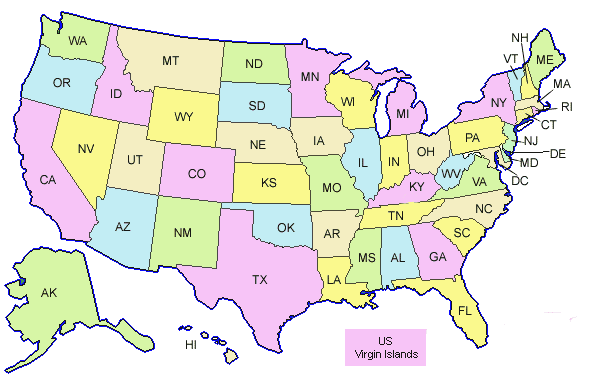
If there is no information shown for a state, it means that there are no entires for it.
You chose to view information for: california | tennessee | georgia
California Adoption
California permits the following types of adoptions in addition to public adoptions:
| Adoption Type | Yes/No |
|---|---|
| Private Agency | Yes |
| Private Attorney | No |
| Independent | Yes |
Adoption Statute-Non-Agency; Independent; Private Adoptions:
- Private Agency Adoption: Family Code section 8700, et seq. for private agency adoptions. Family Code section 8900, et seq. for private adoption agencies that provide inter-country adoption services.
- Private Attorney Adoption: An attorney is not identified as a placing agency in Family Code sections 8700, et seq. and 8900, et seq. Family Code section 8801.5 specifies that the birth parent places child in an independent adoption.
- Independent Adoption: Family Code section 8800, et seq.
Public
Public Adoptive Placement-Requirements:
California Code of Regulations, Title 22, Division 2, Chapter 3, Subchapter 5-Agency Adoptions.
Independent/Private/Public
The following information applies to independent, private and public adoptions:
Adoption Assistance
Adoption assistance payments begins
- Other : AAP benefits may begin any time after the signing of the adoptive placement agreement and the AAP agreement. The date AAP benefits may begin is the date stated on the AAP agreement. If the adoptive parents choose to defer AAP benefits, including Medicaid, they will need to sign a deferred AAP agreement to retain the child's AAP eligibility prior to the adoption finalization.
Sending State Adoption Subsidy Payments (Guidelines):
- No information provided
Special Needs
California definition of "Special Needs":
Welfare and Institutions Code section 16120 (a)-(c) defines special needs. Special needs child means a child for whom all the following are true.
(a) It has been determined that the child cannot or should not be returned to the home of his or her parents, as evidenced by a petition for termination of parental rights, a court order terminating parental rights, a signed relinquishment or in the case of a tribal customary adoption, if the court has given full faith and credit to a tribal customary adoption order as provided for pursuant to paragraph (2) of subdivision (e) of Section 366.26.
(b) The child has at least one of the following characteristics that is a barrier to his or her adoption:
(1) Adoptive placement without financial assistance is unlikely because of membership in a sibling group that should remain intact, or by virtue of race, ethnicity, color, language, age of three years or older, or parental background of a medical or behavioral nature that can be determined to adversely affect the development of the child.
(2) Adoptive placement without financial assistance is unlikely because the child has a mental, physical, emotional, or medical disability that has been certified by a licensed professional competent to make an assessment and operating within the scope of his or her profession. This paragraph shall also apply to children with a developmental disability as defined in subdivision (a) of Section 4512 of the Welfare and Institutions Code, including those determined to require out-of-home nonmedical care as described in Section 11464 of the Welfare and Institutions Code.
(c) The need for adoption subsidy is evidenced by an unsuccessful search for an adoptive home to take the child without financial assistance, as documented in the case file of the prospective adoptive child. The requirement for this search shall be waived when it would be against the best interest of the child because of the existence of significant emotional ties with prospective adoptive parents while in the care of these persons as a foster child.
Finalization
Adoption may be finalized in another state:
- Yes
Before finalization can occur in , child must be in adoptive placement:
- 6 months
- Other
***Note these exceptions apply to all agency adoptive placements, including relative adoptive placements.
The agency shall supervise the adoptive placement for a period of six months except in any of the following circumstances:
(1) The prospective adoptive parent had an approved assessment and successfully completed the adoption of another child in California within the past five years and the placement was supervised by an agency.
(2) The prospective adoptive parent is commissioned or enlisted in the military service, or auxiliary of the United States, or is engaged in service on behalf of any governmental entity of the United States, or employed by the American Red Cross, or in any other recognized charitable or religious organization, whereas, completion of the six month supervisory period would delay completion of an adoption which the agency has determined should be completed.
(3) The child to be adopted is a foster child of the prospective adoptive parent whose foster care placement has been supervised by an agency before the signing of the adoptive placement agreement in which case the supervisory period may be shortened by one month for each full month that the child has been in foster care with the family.
(A) If the placement of a child was a voluntary foster care arrangement with no supervision by an agency, the adoptive placement shall be subject to a full six-month period of supervision that shall begin at the time the adoptive placement agreement is signed.
(4) The child to be adopted was a foster child placed with a relative or a relative of the child’s half sibling whose foster care placement has been supervised by an agency before the signing of the adoptive placement agreement in which case the supervisory period may be shortened by one month for each full month that the child has been in foster care with the relative.
Statutory code/cite for Adoption Petition:
Family Code sections 8714 (a)-(f) for public and private agency adoptions. Family Code section 8802 for independent adoptions. Family Code section 8912 for intercountry adoptions.
Court Jurisdiction for Adoption Cases:
California Superior Court (Family Code section 200)
Home Study (Adoptions)
Statutory code/cite for the Adoptive Home Studies:
Family Code section 8621 provides the authority to establish regulations governing adoptions in California. California Code of Regulations (CCR) Title 22, Subchapter 5, section 35180 for agency adoptions. CCR, Title 22, Subchapter 6 for inter-country adoptions. CCR, Title 22, Subchapter 4 for independent adoptions.
Georgia Adoption
Georgia permits the following types of adoptions in addition to public adoptions:
| Adoption Type | Yes/No |
|---|---|
| Private Agency | Yes |
| Private Attorney | Yes |
| Independent | Yes |
Adoption Statute-Non-Agency; Independent; Private Adoptions:
- Private Agency Adoption: O.C.G.A 19-8-4
- Private Attorney Adoption: Code not specific to this only to 3rd party adoptions in which attorneys are typically involved.
- Independent Adoption: O.C.G.A 19-8-5
Public
Public Adoptive Placement-Requirements:
O.C.G.A. 19-8-4
Independent/Private/Public
The following information applies to independent, private and public adoptions:
Adoption Assistance
Adoption assistance payments begins
- At the time the child is placed
Sending State Adoption Subsidy Payments (Guidelines):
No information Provided
Special Needs
Georgia definition of "Special Needs":
See ODIS, Section 109
Finalization
Adoption may be finalized in another state:
- Yes
Before finalization can occur in , child must be in adoptive placement:
- 6 months
Statutory code/cite for Adoption Petition:
O.C.G.A. 19-8-13
Court Jurisdiction for Adoption Cases:
Superior Court per O.C.G.A. 19-8-2 except such jurisdiction as may be granted to the juvenile court.
Home Study (Adoptions)
Statutory code/cite for the Adoptive Home Studies:
A home study is not requested by State Law, O.C.G.A. sets out petition requirements; 19-8-6 requires investigation of the allegations set forth including CRC on petitions. DFCS requires HS for public agency adoptions.
Tennessee Adoption
Tennessee permits the following types of adoptions in addition to public adoptions:
| Adoption Type | Yes/No |
|---|---|
| Private Agency | Yes |
| Private Attorney | No |
| Independent | Yes |
Adoption Statute-Non-Agency; Independent; Private Adoptions:
TCA sec 36-1-108; 37-5-507; 71-3-501-71-3-531
TCA sec. 37-5-507
TCA sec 36-1-108
Public
Public Adoptive Placement-Requirements:
- persons twenty-one (21) years of age or older (relatives eighteen (18) years of age or older may be considered to become a resource parent for a sibling or other blood relative)
-regardless of gender, race, color or national origin.
- married or single
- a legal resident of Tennessee for at least six (6) months
- a United States citizen. ( Applicants may also have Legal Permanent Resident Status that has been approved by the United States Citizenship and Immigration Service)
- -mutual selection process
- based on the applicant’s ability to meet specific approval requirements including interview process, home visits, Parents As Tender Healers training (PATH), home safety requirements,, physical, mental and emotional health requirements, and fire safety standards including diaster planning, income and financial stability,legal marital status, background and criminal records check including FBI/TBI fingerprint checks and specific Internet Records check, references and continuing education;
- ability to partner with and promote the Department’s Standards of Professional Practice.
TCA sec 36-1-108 (b)
Independent/Private/Public
The following information applies to independent, private and public adoptions:
Adoption Assistance
Adoption assistance payments begins
- After the adoption is finalized
Sending State Adoption Subsidy Payments (Guidelines):
Special Needs
Tennessee definition of "Special Needs":
Special Needs Child: Caucasian child(ren), age nine (9) and above; African American child(ren), age three (3) and above; Child(ren) of mixed race, age three (3) and above; any race/any age sibling group of three or more children or any race/any age child(ren) who has (have) a severe physical, emotional or behavioral handicap(s) which would present a significant challenge to the adoptive placement.
Special Needs: DCS term relating to youth identified as needing continued services for behavioral/mental health issues, or youth diagnosed as being mentally retarded (IQ of 70 or below). See DCS policies 19.7, Transitioning DCS Youth into Adult Behavioral/Mental Health Services and 19.8 Transitioning Youth into the Division of Mental Retardation Services (DMRS) Adult Services for additional qualifications.
Finalization
Adoption may be finalized in another state:
- Yes
Before finalization can occur in , child must be in adoptive placement:
- 6 months
f the child is related to the petitioners, the TN court may , in its discretion, waive the six-month waiting period, . . . or if the child has already resided in the home of the petitioners for six (6) months, the TN court has received the final court report concerning the circumstances of the child and the petitioners, and is satisfied that the adoption will be in the best intrest of the child, the TN court may waive the six-month waiting period after the filing of the adoption petition and may enter an order of adoption. (TCA sec 36-1-119 (a) - (e) )
Statutory code/cite for Adoption Petition:
TCA sec. 36-1-115
Court Jurisdiction for Adoption Cases:
Circuit & Chancery Courts TCA 36-1-101 and 16-10-108
Home Study (Adoptions)
Statutory code/cite for the Adoptive Home Studies:
TCA sec 36-1-115 Statutory code/cite for adoption pre-petition home study or preliminary home study concerning suitability of home TCA sec 36-1-116